Waves & Oscillations
- Every oscillatory motion (small frequency) is vibratory motion (large frequency) but not vice a versa
- SHM > Force is directly proportional to displacement from mean / equilibrium position
F = -Kx (Springs – Hooks law), Displacement is sinusoidal function of time
Frequency = 1 / time, w (Angular frequency) = 2 (pi) / t, T = 2 (pi) (L/g)1/2
Light & sound wave form > Transfer of energy without net transfer of matter
Mechanical waves
- Waves which require a medium to propagate.
- Cannot travel through vacuum
- For ex. sound waves (longitudinal waves), Seismic waves, Water waves, Waves on a string etc.
Non Mechanical waves
- Waves which do not require a medium to propagate (Electromagnetic waves).
- Can even travel through vacuum
- For ex. Radio waves, Light waves, X rays, UV waves, IR rays
Frequency = No. of waves passing through a point per unit second
Sound Waves |
|
|
|
|
|
| Speed of sound increases with increase in temp of air (due to fast movement of molecules) > Vwarm air > Vcold air | Speed of sound decreases with increase in altitude (due to lower no. of molecules available to displace) |
|
Speed of sound is greater in water than in air hence Vhumid air > Vdry air |
|
Echo (Reflection of sound)
- To measure depth of sea beds using SONAR
- To detect oil & gas underwater
- Used for Ultrasonography
Resonance
Natural frequencies of an object, when set in oscillation continuously leads to greater amplitudes even with smaller forces or oscillations, for ex.
- Driver jumping on swimming pool jump boards continuously to gain more amplitudes
- Soldiers walking slow on suspension bridges
Doppler Effect
- Change in frequency of a wave (sound or light) due to motion of source or observer
- Higher is the frequency when source is approaching the observer & vice a versa

Examples are
- Whistle of a train
- Speed guns used by traffic police
- Star receding (Red shift) or approaching (Blue shift)
- Rotation of star
Beats
- Arise from the interference of waves
- When 2 harmonic waves of close frequencies are heard at a same time, we hear audibly distinct waxing & waning intensity of sound
- Artists tune their devices not to detect any beats
Electromagnetic Spectrum
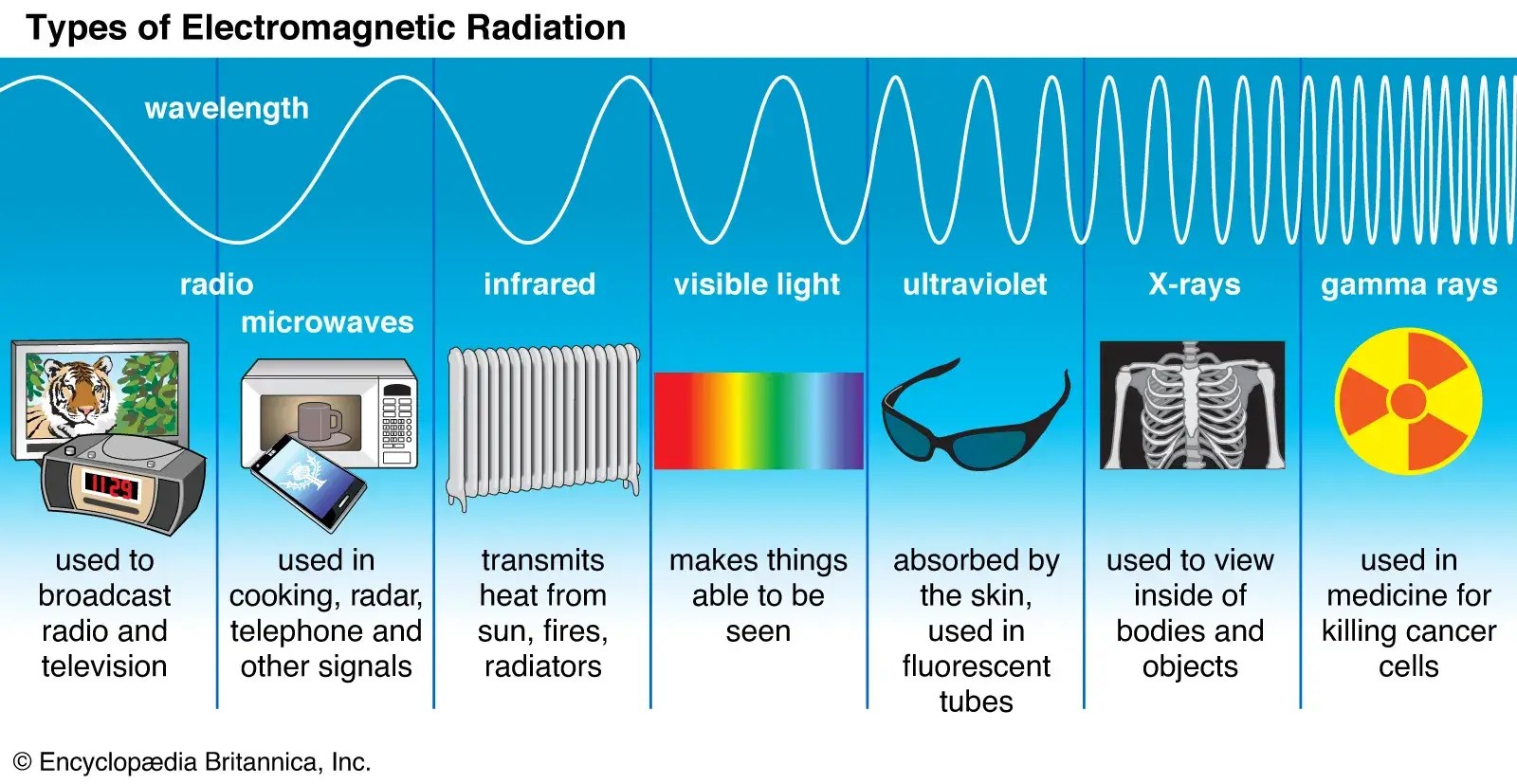
| Radio waves | Produced by accelerated motion of charge in wiresUsed in Radio & TV communication systems, Cellular phones, MRI |
| Microwaves | Used in Radar system; Aircraft navigationSpeed guns in cricket, Tennis, AutomobilesOvens & Vacuumed tubes |
| IR waves | Produced by hot bodies, also known as heat waves (Maintain earths warmth)Used as IR detectors in satellite for military & observing growth of cropsUsed in TV remotes & widely used in Photography. |
| Visible Rays | Visible range – Wavelength (700 – 400 nm) |
| UV rays | Produced by very hot bodies ex. sunAbsorbed by ordinary glasses (Welders wear glass goggles to protect their eyes from harmful UV rays, produced during welding)UV lamps are used to kill germs in water purifiers |
Oscillations are repetitive back-and-forth movements of an object about a mean position, commonly seen in Simple Harmonic Motion (SHM).
Waves are disturbances that transfer energy from one point to another without permanent displacement of the medium, such as mechanical, sound, and electromagnetic waves.
For more updates, explore the Physics. Feel free to share your thoughts and comments.
If you’re passionate about building a successful blogging website, check out this helpful guide at Coding Tag – How to Start a Successful Blog. It offers practical steps and expert tips to kickstart your blogging journey!
Discover more from | News and UPSC Portal
Subscribe to get the latest posts sent to your email.

 Admin
Admin