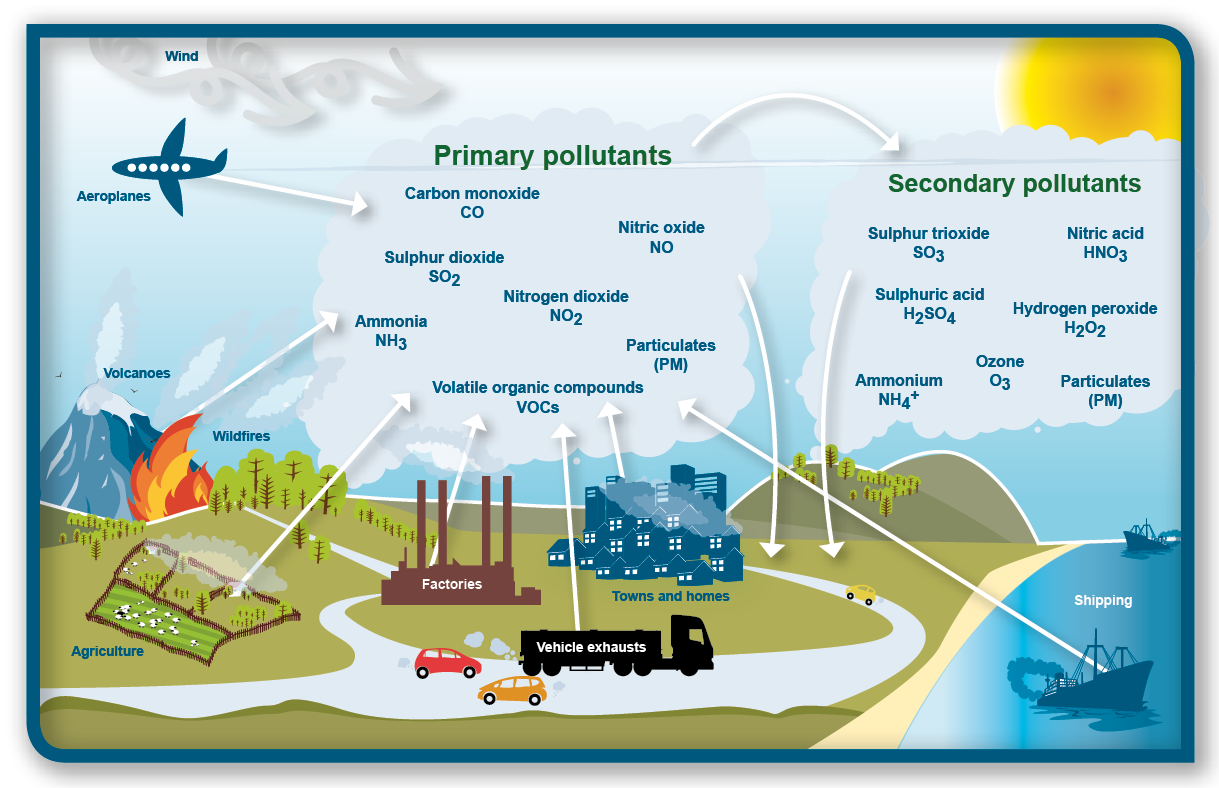
Environment Pollution – Air Pollutants

air pollution

Environment Pollution – Air Pollutants

Environmental Pollution

Pollution is the introduction of contaminants into the natural environment that cause adverse change. Pollution can take the form of chemical substances or energy, such as noise, heat or light.

Pollutants, the components of pollution, can be either foreign substances/energies or naturally occurring contaminants.

Primary Pollutants Persist in the form in which they are added to the environment for ex. DDT, Plastic
Secondary Pollutants Formed by interaction among primary pollutants viz. PAN by interaction of NOx & Hydrocarbons
Biodegradable Pollutants Waste products which are degraded by microbial action for ex. Sewage
Non-Biodegradable Pollutants Not decomposed by microbial action for ex. Plastic, Glass, DDT, Radioactive substances
Quantitative Pollutants Occur in nature & become pollutant when their concentration reaches beyond a threshold level for ex. CO2, NOx
Qualitative Pollutants  Do not occur in nature & are man-made for ex. fungicides, herbicides, DDT


Air Pollutants

Major Air Pollutants

 CO
  • By incomplete combustion of carbon-based fuels, Automobile exhaust, Cigarette smoke
  • Combines with haemoglobin to form carboxyhaemoglobin, which is highly stable & reduces oxygen carrying capacity of blood
  • Slow our reflexes & make us confused & sleepy
CO2
  • Major greenhouse gas formed by respiration, burning of fuels, decomposition of lime, volcanic eruption
 CFCs
  • Released mainly from air conditioning systems & refrigeration
  • Detrimental to Ozone layer present in the stratosphere as CFC + UV >> Cl (Chlorine radicals which causes breakdown of Ozone)
Lead
  • Present in petrol, diesel, lead batteries, paints, hair dye products etc. (Affects children in particular)
  • Damages nervous system & cause digestive problems & in some cases causes cancer
O3
  • Formed when NOx particle from vehicle exhaust & volatile Hydrocarbons interact with each other in presence of sunlight
SPM
  • SPMs in air, when breathed in causes lung damage & respiratory problems
SO2
  • Produced from burning coal (60 %), mainly in thermal power plants + Petroleum products + in production of paper & smelting of metals
  • Major contributor to smog causing lung diseases
CH4
  • Mainly CH4 burns in fossil fuels + produced by burning of vegetation / rotting
Acid Rain
  • Ph < 5.6 (Rain with oxides of sulphur & nitrogen (SO2 & NO2)) – HNO3 + H2SO4
NOx
  • NO3- > Acts as a fertilizer to the soil
  • Automobile exhaust produces NO2 which damages plant leaves & retard rate of photosynthesis + also causes red haze & lung irritation
Classical Smog
  • Occurs in cool humid climate
  • Chemically reducing hence called reducing smog.
  • Smoke + fog + SO2

Ph value is a logarithmic index for hydrogen ion concentration in an aqueous solution, & each increasing Ph value diminish acidic nature of the solution by 1/10th.

Photochemical Smog 
  • Occurs in warm, dry & sunny climate
  • Result from the action of sunlight on unsaturated HC & NOx produced by factories & automobile
  • Chemically oxidising hence called oxidising smog
  • Ozone + Acrolein + Formaldehyde + Peroxyacetyl Nitrate (PAN) are produced which cause serious health problems, severe plant damage, cracking of rubber & corrosion
  • Catalytic Converter – Prevent release of NO & HC to environment
GHGs
  • CO2, CH4, CFC, N2O, SF6, HFCs, PFCs, CCl4, CH3CCl3,  Water Vapour, O3
Formaldehyde
  • Mainly from carpets, particle boards & insulation foam > Causes irritation & allergies
 Radon
  • A gas naturally emitted by soil
  • Due to poor ventilation it is confined inside house & causes lung cancer

Fly Ash

  • Residue produced whenever combustion of solid material takes place, which rises with the gases in atmosphere & causes respiratory problems
  • Contains Aluminium silicates, SiO2 & Calcium oxide (CaO) + Toxic metals like lead, arsenic, cobalt etc.
Advantages of Fly Ash
  • Cement can be replaced by fly ash up to 35 % hence reducing cost of construction
  • Fly ash bricks are lighter in weight & offer high strength & durability
  • A better fill material for road embankments & concrete roads
  • Can be used in reclamation of wasteland, can increase crop yield & enhances water holding capacity of land

Sources of Air Pollutant Emission:  Industry > Transportation > Agriculture


Diseases By Air Pollutants

Yokkaichi asthma (SO2)

  • Burning of petroleum and crude oil releases large quantities of sulfur oxides which causes severe smog
  • Results in severe cases of chronic obstructive pulmonary disease, chronic bronchitis, pulmonary emphysema, and bronchial asthma

Pneumoconiosis / Black Lung Disease

  • an occupational lung disease caused by inhalation of coal dust, often in mines

Asbestosis

  • a lung disease, which leads to long-term breathing complications, caused by exposure to asbestos (No cure)

Silicosis

  • a lung disease that is caused by inhaling tiny bits of silica mainly by the workers working in silica industries or sand blasting sites

Emphysema

  • Breaking down of lung tissues due to air pollution & cigarette smoke leading to difficulty in expanding & contracting of lungs

For more updates, explore the Environment category. Feel free to share your thoughts and comments

If you’re passionate about building a successful blogging website, check out this helpful guide at Coding Tag – How to Start a Successful Blog. It offers practical steps and expert tips to kickstart your blogging journey!


Discover more from | News and UPSC Portal

Subscribe to get the latest posts sent to your email.

Leave a Reply

Your email address will not be published. Required fields are marked *

You May Also Like
ECOLOGICAL SUCCESION

Ecological Succession, Food Chain, Food Web, Ecological pyramids

Ecological Succession, Food Chain, Food Web, Ecological pyramids Ecological Succession Primary succession Primary succession is one of two types of biological and ecological succession of plant life, occurring in an…
View Post
Ecology Biome Ecotone Niche Ecosystem Biosphere

Ecology, Biome, Ecotone, Niche, Ecosystem, Biosphere

Ecology, Biome, Ecotone, Niche, Ecosystem, Biosphere Ecology Ecology may be defined as the scientific study of the relationship of living organisms with each other and with their environment. The emphasis…
View Post
Bioaccumulation vs Bioconcentration vs Biomagnification Composting Vemiculture

Bioaccumulation vs Bioconcentration vs Biomagnification + Composting + Vemiculture

Bioaccumulation vs Bioconcentration vs Biomagnification + Composting + Vemiculture Pyrolysis “Combustion in absence of oxygen or in controlled atmosphere of oxygen” Composting A biological process (in-situ) in which microorganisms, mainly…
View Post
forest ecosystem

Forest Ecosystem

Forest Ecosystem Tundra Ice frozen soil with severe climatic conditions Tropical Lying near the tropics or in equatorial region Temperate Between Tropics & Arctic circles i.e. from 23.5* to 66.5*…
View Post
Biodiversity Conservation 1

Different types of Species

Different types of Species  Keystone species Species which determine the ability of a large number of other species to survive. Extinction of keystone species has snowballing effect on extinction of…
View Post
Greenhouse Effect Greenhouse Gases

Greenhouse Effect & Greenhouse Gases

Greenhouse Effect & Greenhouse Gases The exchange of incoming and outgoing radiation that warms the Earth is often referred to as the greenhouse effect because a greenhouse works in much…
View Post
acquartic

Aquatic Ecosystems & Eutrophication

Aquatic Ecosystems & Eutrophication An aquatic ecosystem is an ecosystem in a body of water. Communities of organisms that are dependent on each other and on their environment live in…
View Post
mangroves

Mangroves and Coral Reefs

Mangroves and Coral Reefs Mangroves Mangroves are the trees & bushes growing below the high-water level of spring tides, which exhibits remarkable capacity for saltwater tolerance. Basically, Littoral evergreen land…
View Post
water pollution

Biogeocycles: Water Cycle, Carbon Cycle, Nitrogen Cycle

Biogeocycles: Water Cycle, Carbon Cycle, Nitrogen Cycle Mineral nutrients are always in circulation, moving from non-living to living & then back to non-living components of ecosystem in a more or…
View Post
Plant Classification Parts of Tree

Plant Classification & Parts of Tree

Plant Classification & Parts of Tree The Classification Of Plants is mainly based on the plant Taxonomy, life cycle, flowering, non-flowering, and the number of seeds. Herb A plant whose…
View Post