Administrative Tribunals

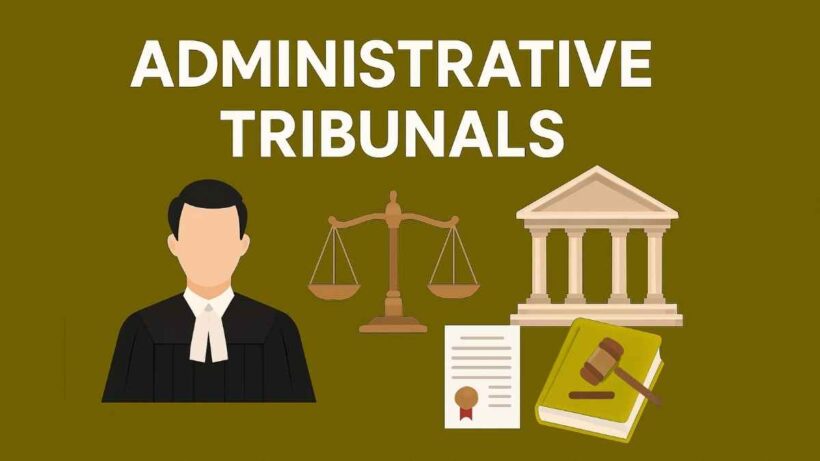
Administrative tribunal

Administrative Tribunals

“Tribunals are meant to relieve the courts of overload & expedite the process of justice in interest of affected officials”

Administrative Tribunals (Article 323A)

  • It authorises parliament to setup administrative tribunals for the purpose of setting disputes & complains involving civil services
  • It also authorize parliament to establish an administrative tribunal for the union & a separate administrative tribunal for state or for two or more states

Central Administrative Tribunal (CAT) > For Union services including AIS

The CAT exercises jurisdiction over all service matters concerning the following:

  • a member of any All-India Service
  • a person appointed to any civil service of the Union or any civil post under the union
  • a civilian appointed to any defence services or a post connected with defence

However, the members of the defence forces, officers, staff of the Supreme Court and the secretarial staff of the Parliament are not covered under the jurisdiction of CAT.

State Administrative Tribunal (SAT) > For states services including state PSC

Following categories of employees are exempted from purview of administrative tribunal:
  • Employees of SC & HC
  • Armed force professionals
  • Rajya Sabha & Lok Sabha members

Also read: Local Government State in India


Points of Prominence

  • SC may grant a writ of certiorari if a tribunal’s decision infringes an FR
  • Chairman & members of CAT & SAT are appointed by President after consultation with CJ
  • Chairman & Vice Chairman retire at the age of 65 + Other members retire at the age of 62
  • Chairman > Must be a HC judge (Serving/Retired) or VC of tribunal for atleast 2 years
  • Members of administrative tribunals can be Judges of HC & or from civil services

Tribunal for other Services (323B)

For jurisdiction of disputes relating to following matters

  • Taxation
  • Foreign exchange (export & import)
  • Land reforms
  • Industrial & labour disputes
  • Ceiling on urban property
  • Election to parliament or state legislature
  • Rent & Tenancy Issues
  • Production, procurement & distribution of food stuff

If you’re passionate about building a successful blogging website, check out this helpful guide at Coding Tag – How to Start a Successful Blog. It offers practical steps and expert tips to kickstart your blogging journey!

For dedicated UPSC exam preparation, we highly recommend visiting www.iasmania.com. It offers well-structured resources, current affairs, and subject-wise notes tailored specifically for aspirants. Start your journey today!

Discover more from | News and UPSC Portal

Subscribe to get the latest posts sent to your email.

Leave a Reply

Your email address will not be published. Required fields are marked *

You May Also Like
local government system in india

Local Government System in India

Local Government System in India Local Governance in India has been formalized under the Panchayati Raj System since 1992. The Panchayati Raj system is a three-tier system with elected bodies…
View Post
Vice President of India

Vice President: Qualification, Election, Removal, Emoluments

Vice President: Qualification, Election, Removal, Emoluments Vice President Appointed for 5 years. Ex- officio chairman of council of states (Rajya Sabha) 2nd highest dignitary of India, occupying 2nd place in…
View Post
The Parliament %E2%80%93 President Rajya Sabha Lok Sabha

The Parliament – President, Rajya Sabha & Lok Sabha

The Parliament – President, Rajya Sabha & Lok Sabha Indian Parliament President Council of states (Rajya Sabha) House of the people (Lok Sabha) Though President is not the member of…
View Post
President: Qualification, Election, Powers, Removal

President: Qualification, Election, Powers, Removal

 President: Qualification, Election, Powers, Removal President Elected for 5-year term & eligible for re-election. Executive head of India & all the executive powers of the union shall be vested in…
View Post
Union its Territories %E2%80%93 Formation of States in India

Union & its Territories – Formation of States in India

Union & its Territories – Formation of States in India Article 1 of Indian Constitution defines names & territories of nation >> Describes India as union of states (Not federation…
View Post
Speaker of Lok Sabha, Chairman of Rajya Sabha

Speaker of Lok Sabha, Chairman of Rajya Sabha

Speaker of Lok Sabha, Chairman of Rajya Sabha The Speaker of the Lok Sabha is the presiding officer of the Lok Sabha, the lower house of the Parliament of India.…
View Post
Features of Indian Constitution

Features of Indian Constitution

Features of Indian Constitution Indian Constitution “Sovereign, Socialist, Secular, Democratic Republic + Supreme law of the Nation + Written & lengthiest of the world” 12 Schedules of Indian Constitution Schedule Description 1…
View Post
Special Provisions for states Article 371

Special Provisions for states (Article 371)

Special Provisions for states (Article 371) Article 371 > Special Provisions for Maharashtra & Gujrat President is authorised to provide that Governor of Maharashtra & Gujrat would have special responsibilities…
View Post
Center State Relations

Center State Relations

Center State Relations Union List 100 items (Exclusive authority of Union) Concurrent list 52 items (Authority of both center & state) State List 61 Items (5 items transferred to concurrent…
View Post