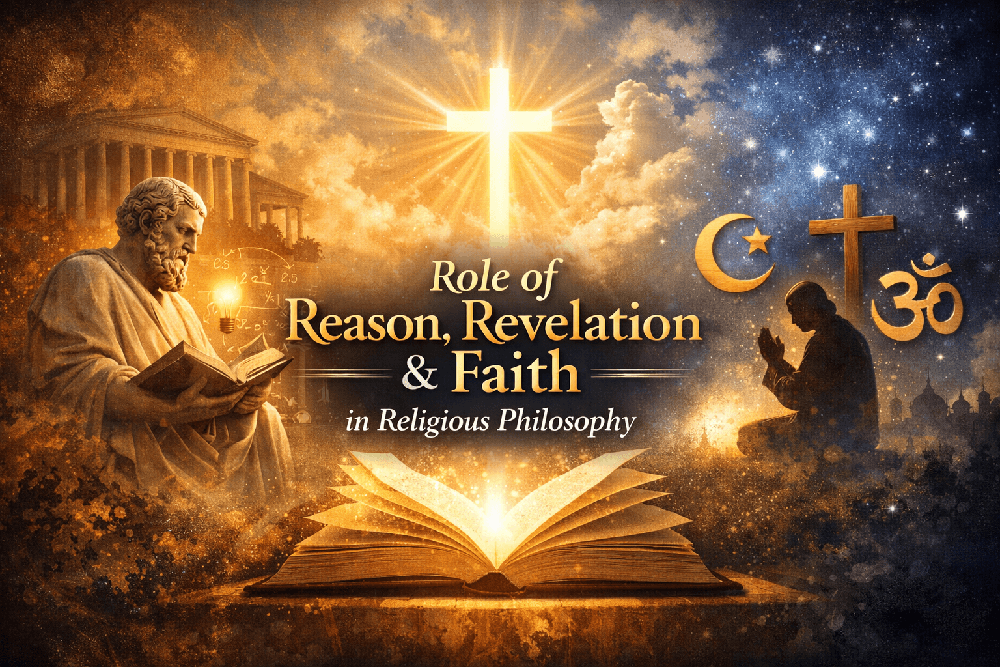
Religious philosophy explores the foundations of human belief, morality, and spirituality. Three key sources of authority—Reason, Revelation, and Faith—play distinct yet interconnected roles in shaping religious understanding.
Each contributes uniquely to how humans comprehend the divine, the cosmos, and moral truth.
What is Reason?
Reason refers to the human capacity to think logically, analyze evidence, and draw inferences to discover truth. It underpins uniquely human pursuits such as philosophy, science, mathematics, language, and art.
Logic, as a formal study of reasoning, enables people to construct coherent arguments and move from one notion to another.
In religious philosophy, reason provides the rational foundation for belief. It evaluates claims, interprets revelation, and offers moral guidance.
While faith may appear irrational, reason ensures that beliefs are coherent and meaningful.
What is Faith?
Faith is often understood as trust or confidence in something beyond immediate perception or proof. In a religious context, it is the belief in God, divine principles, or spiritual truths that may surpass human understanding.
Faith is cultivated through adversity and refinement, linking personal growth with spiritual insight.
Unlike reason, it is primarily subjective and experiential, rooted in trust rather than logical deduction. Faith empowers individuals to embrace the unseen, act morally, and commit to religious life.
What is Revelation?
Revelation is the disclosure of divine truth to humanity. It may occur through mystical experiences, historical events, or the teachings of spiritual leaders. Revelations provide privileged insights into the nature of existence, God, and the cosmos, often inaccessible to reason alone.
In religious philosophy, revelation serves as a bridge between the human and divine, offering truths that guide faith and moral action. While reason interprets, and faith internalizes, revelation delivers knowledge that is otherwise unattainable through logic.
Interconnection Between Religion and Faith
Faith and religion, while closely linked, are distinct:
- Faith is personal, internal, and often ineffable, relying on trust and belief.
- Religion is communal, external, and structured, encompassing rituals, doctrines, ethics, and institutions.
Faith often motivates religious practice, while religion provides a framework to express faith through rituals, art, music, and community.
Together, they allow humans to connect with divine realities in both private and social contexts.
Role of Reason, Revelation, and Faith in Religious Philosophy
- Reason ensures beliefs are coherent, justifiable, and ethically grounded.
- Revelation offers knowledge beyond human logic, guiding moral and spiritual understanding.
- Faith internalizes these truths, creating trust in the divine and commitment to spiritual life.
These three elements interact synergistically: reason evaluates, revelation informs, and faith enlivens belief. Religious philosophy thus balances rational understanding with personal trust and divine insight.
Conclusion
The study of reason, revelation, and faith reveals that human understanding of religion is multi-dimensional.
Reason provides logical clarity, revelation delivers divine knowledge, and faith allows humans to embrace, internalise, and live these truths.
Together, they form the foundation of religious philosophy, enabling individuals to navigate questions of existence, morality, and spirituality.
How to start a Blogging Journey – Step by Step Guide – Coding Tag

 Shashi Gaherwar
 Admin
Admin
 Lalit Bhatia

 Punam Shivankar